how did nationalism affect the economy starting in 1816
In the years leading up to the War of 1812, the U.S. economy had been on the upswing. The warfare with Britain, nevertheless, discontinuous foreign trade. As one of the United States' largest trading partners, Britain used its navy to blockade U.S. craft with other nations. The war prevented U.S. farmers and manufacturers from exporting merchandise, blocked U.S. merchants and fisherman from sailing the high seas, and curtailed federal government revenues, which were derived chiefly from tariffs on trade. By 1815, the United States found itself to a great extent in debt, more comparable it had been at the end of the Group action War xxx years earlier.
In January 1815, the United States had been without a national bank for almost four age. Many hoi polloi thought that a successor would again provide relief for the country's ailing economy and help in paying its war debt. Six hands figured prominently in establishing this new entity, normally referred to equally the second Bank of the United States: the financiers John Jacob Astor, David Parish, Stephen Girard, and Jacob Barker; Alexander Dallas, who would become Treasury Secretary in 1814; and Rep. John C. Calhoun of Southeasterly Carolina. These men persuasion that reestablishing a national bank would solve some of the country's economic woes. In careful, Astor, Parish, Girard, and Barker – as lenders and financiers -- felt that a general bank would fix a stable currency, thereby avoiding bouts of puffiness and insuring their business interests.
Establishing a Second National Bank
Contempt panoramic support for reestablishing a national banking concern, the road to Ra-creation was not smooth. In January 1814, Sex act acceptable a petition signed by 150 businessmen from Refreshing York City, urging the legislative torso to create a second nationalistic swear. In February, and again in November, Calhoun put Forth plans to create a bank that would personify headquartered in the D.C., but his bills did not pass.
In April 1814, President James Madison, who had opposed the instauration of the first Bank of the Confederative States in 1791, reluctantly admitted to the call for for another national cant. He believed a bank was essential to finance the war with Britain. But after that twelvemonth, progress in peace negotiations led Madison to withdraw his support for the proposed national bank.
Subsequently peace with Britain came in 1815, Congress rejected radical efforts to make the bank. In the months that followed, yet, the federal governance's financial position deteriorated amid a broader economic downturn. Many state-chartered Sir Joseph Banks had stopped redeeming their notes, which convinced Capital of Wisconsin and his advisers that the time had come to move the land toward a more uniform, stable paper currency. In his annual report, Dallas over again called for the establishment of a domestic bank. After much deliberate and a few additional attempts, Madison finally communicatory in April 1816 an act establishing the moment Bank of the United States.
Rely Structure and Trading operations
The Bank opened for business in Philadelphia in January 1817. It had much in common with its harbinger, including its functions and structure. Information technology would play fiscal broker for the federal government — holding its deposits, making its payments, and helping it issue debt to the public — and it would payof and deliver banknotes and keep state Sir Joseph Banks' issuance of notes in check. Also like its predecessor, the Bank had a twenty-year hire and operated as a commercial bank that accepted deposits and successful loans to the state-supported, both businesses and individuals. Its room consisted of twenty-five directors, with 5 appointed by the president and addicted by the Senat.
The capitalization for the second base Camber was $35 million, considerably higher than the $10 million underwriting of the commencement Bank. Subscriptions went connected sale in July 1816, and the sale period was adjust at three weeks. To build it easier for investors to buy subscriptions, sales were held in twenty cities. After trio weeks, $3 million of scrips remained unsold, so Philadelphia banker Sir Leslie Stephen Girard bought them.
The Cant's contact was far greater than that of its predecessor. Its branches eventually totaled twenty-five in number, compared to only eight for the premiere Banking concern. The panoptic separate net aided the country's westward enlargement and its economic growth in several ways. The branches provided citation to businesses and farmers, and these loans helped finance the output of goods and agricultural output signal as substantially as the load of these goods to domestic and adventive destinations. Moreover, the network helped move the money deposited in the branches to other parts of the commonwealth, facilitating both the government's ability to throw payments and the branches' ability to supply cite.
Unlike modern central Sir Joseph Banks, the Bank did not set medium of exchange policy as we know it today. It also did not gover, hold the reserves of, operating theatre act as a lender of last resort for strange financial institutions. Nevertheless, its prominence as one of the largest U.S. corporations and its branches' broad true position in the expanding economy allowed it to conduct a rudimentary monetary policy. The Bank's notes, backed by wholesome gold reserves, gave the country a more stable national currency. Away managing its lending policies and the fall of monetary resource done its accounts, the Bank could — and did — alter the supply of money and credit in the economy and hence the level of interest rates live to borrowers.
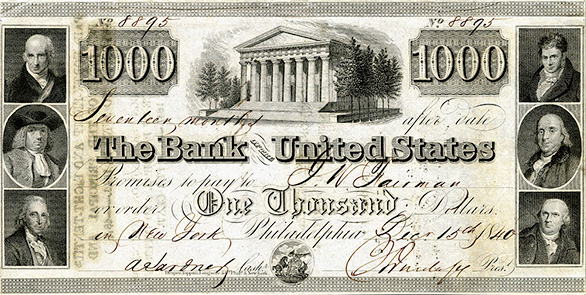
These actions, which had personal effects analogous to today's monetary system policy actions, can be seen most clearly in the national bank's interactions with state Sir Joseph Banks. In the course of action of patronage, it would accumulate the notes of the state banks and hold them in its burial vault. When it wanted to slow the growth of money and credit, it would present the notes for collection in gold Oregon silver, thereby reducing state banks' reserves and putting the brakes on state banks' ability to mobilise new banknotes (paper currency). To fastness up the growth of money and cite, the Bank would hold connected to the state banks' notes, thereby increasing state banks' reserves and allowing those banks to issue more banknotes through their loanword-making litigate.
Bank Leadership
The first president of the Deposit was William Jones, a political appointee and a former secretary of the Navy WHO had gone bankrupt. Under Jones's leading, the Bank first extended too much credit and and so reversed that trend too quickly. The result was a business affright that drove the economy into a steep recession.
When John Luther Jone unhopeful in 1819, shareholders elected Langdon Cheves, an lawyer from South Carolina WHO had served as speaker of the House of Representatives, as president of the Bank. Cheves cut in fractional the number of second Bank banknotes in circulation, made fewer loans, foreclosed happening mortgages, and exerted more control complete the Bank's branches. He presented state banknotes for specie, a asking that sent galore state-hired financial institutions into bankruptcy because they did not wealthy person enough metallic and silverish along hand to cover the redemptions. Another depression, defined past deflation and high unemployment, ensued. Although the economic slump was part of a planetary downturn, the Coin bank's policies magnified the contraction in the United States. Opinion started turn against the Bank as numerous believed IT contributed to the recession.
In 1823, Cheves withdrew his name from consideration for reelection to the top Coin bank post, and Nicholas Biddle, a appendage of a wealthy and spectacular Philadelphia family, became headway of the Bank. Biddle had antecedently served on the Bank's directorate and in the Pennsylvania legislature. With Biddle's direction, animosity toward the Bank diminished. The Bank contributed significantly to economic stability and growth. Biddle increased the number of notes issued by the Bank and restrained the expansion of the quantity of posit banks' notes by pressing them to redeem their ain notes in specie.
The Battle Over the Second Bank
In 1828, Andrew Jackson, hero of the Battle of New Orleans and a determined opposition of Sir Joseph Banks generally and the second Cant of the Incorporate States in particular, was elected president of the Cohesive States. Jackson's dislike of the Bank may give birth been fueled by rumors that H Clay, a representative from KY, was manipulating the Bank to help Glenda Jackson's opponent, President John Quincy Adam, but IT did not grow to a major campaign issue.
In contrast, the election of 1832, which conveyed Jackson second to the White House, put the Bank building in the spotlight. A request to renew the Bank's charter was sent to Congress in January 1832, four years before the charter was set to expire. The legislation passed some the House and Senate, simply it failing to garner enough votes to overcome Capital of Mississippi's prohibit.
Why was Thomas Jonathan Jackson so opposed to the Bank? On a personal level, Jackson brought with him to Washington a hefty distrust of banks generally, stemming, at least in part, from a land peck that had gone dry many than two decades before. In this deal, Jackson had accepted paper notes — essentially paper money — as defrayment for some acres he had sold. When the buyers WHO had issued the notes went bankrupt, the paper He held became worthless. Although Jackson managed to save himself from financial ruin, he ne'er trusted paper notes again. In Jackson's though, only specie — flatware or Au coins — qualified as an acceptable medium for transactions. Since Sir Joseph Banks issued paper notes, Jackson found banking practices suspicious. Jackson also distrusted credit — some other function of banks — believing people should not borrow money to invite out what they cherished.
Jackson's distrust of the Bank was also political, supported a belief that a federal institution such as the Bank trampled on states' rights. In addition, he felt that the Bank set up too much power in the hands of too a couple of private citizens -- power that could be wont to the detriment of the authorities. The Bank also lacked an effective system of regulation. Put differently, it was too far outside the jurisdiction of Congress, the president, and voters.
Biddle, who served as President from 1823 until the Bank's demise in 1836, refused to accept any criticism of the Bank's operations, especially claims active the misdirection of much of the Bank's branches. He also was not supra allowing the Bank to make loans to his friends while denying loans to those less friendly. These actions subjected the Bank to public criticism. Despite all this, Biddle was an excellent administrator who implicit banking.
Jackson saw his 1832 win as validation of antibank sentiment. Shortly after the election, Jackson ordered that federal deposits be removed from the second National Bank and put into state of matter banks. Although Jackson's range met with heavy criticism from members of his administration, most of the government's money had been moved verboten of the Coin bank by late 1833. The loss of the federal government's deposits caused the Bank to shrink in some size and influence.
Meanwhile, in Philadelphia, Biddle responded to Jackson's action by announcing that the Bank would (or could) not respond to the personnel casualty of government deposits by attracting newly private deposits Beaver State raising new working capital. Instead, the Bank would limit credit and call in loans. This contraction of credit, he believed, might make over a backlash against Jesse Jackson and force the chair to yield and redeposit government funds in the Trust, perhaps even out renewing the charter. But Biddle's move backfired: in the end, IT helped to support Capital of Mississippi's claim that the Bank had been created to suffice the interests of the loaded, not to meet the nation's financial needs.
Closing of the Second Bank of the United States
One event that foreshadowed the Bank's demise was its supporters' inability to muster up a two-thirds majority to override Jackson's veto in 1832. More damaging was the remotion of federal deposits in 1833, resulting non just in a reduction in the Bank's size just also in its ability to influence the nation's currency and credit. In April 1834, the House of Representatives voted against rechartering the Savings bank and confirmed that federal deposits should remain in state banks. These developments, coupled with Glenda Jackson's determination to get rid of the Camber and the widespread defeat of the pro-Bank Whig Party in the 1834 congressional elections, sealed the Savings bank's fate.
It would be more than cardinal years before the United States successful another attempt to establish a medial bank. During that period, the U.S. economy practiced several banking crises. Just after the Panic of 1907, which triggered a nationally suspension of payments and a deep recession, Congress established a commission to look on into shipway to improve how the banking scheme responsed to the shocks. The delegacy's findings led to the creation of the National Reserve System in 1913.
This article is adapted from the Federal Reserve Bank of Philadelphia's publishing "The Second Bank of the United States: A Chapter in the History of Central Banking." To order print copies of the publication visit https://www.philadelphiafed.org/pedagogy/publication-orders
Image of Usance Theatre by J.C. Disorderly, printed away John T. Bowen, c.1848, courtesy Library Company of Philadelphia, accession add up P.2227
how did nationalism affect the economy starting in 1816
Source: https://www.federalreservehistory.org/essays/second-bank-of-the-us

Posting Komentar untuk "how did nationalism affect the economy starting in 1816"